
Notes from Wales
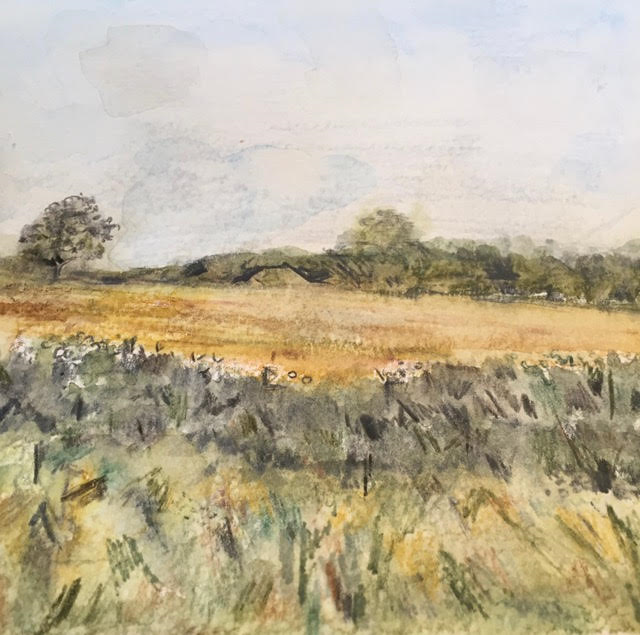
We are standing in a stone circle, built 3,000 years ago, on a rock hilltop 500 million years old. The view is a mosaic of geological history: inundation, subduction, glaciation and erosion have left visible traces wherever we look.
Here a grey crag, there a swooping valley. Here a waterfall carving through dark granite, there a placid lake reflecting the sky. All around, meadows populated by sheep: thoughtful creatures who stare intently then trundle off when we get too close.
Geology was born in Wales. The names we give sections of Earth’s history are Welsh: Cambrian, Ordovician, Silurian. These are Roman words for unruly Welsh tribes who fought everyone from the legions to the Normans until, with the Tudors, they captured the English monarchy.
Edward built a chain of massive, glowering castles to force the Welsh into submission. They didn’t work, but all are ‘worth the detour’. At Crecy, Poitiers and Agincourt Welsh archers, with their Schwarzenegger shoulders, annihilated the French aristocracy. We think of the Welsh as small, dark people chipping away in mines, but they were something else entirely in the Middle Ages.
Wales is neither a destination nor on the way to anywhere. For centuries its people lived in isolated farms. No towns. Their diet was oats, potatoes and milk. Oats and milk for breakfast. Milk soup with oats for dinner. But they could fire arrows from a two-metre bow, hitting the target at 200 metres every time. Their over-developed bones have been found in the wreck of the ‘Mary Rose’.
Then: copper, coal and slate. Landowners suddenly got rich as new industries paid millions for the minerals beneath their fields. The rural landscape was torn apart. 200-metre hills were cut to pieces. 200-metre shafts were driven down and through mountainsides. Enormous caverns were hewn out by hand. The miners worked deep underground by candle-light, never seeing the vast scale of the caves they excavated.
Millions of tons of copper, coal and slate were shipped from Welsh ports to St Petersburg, Auckland and Rio. Canals were dug, 30-metre aquaducts were built to carry them over inconvenient valleys. Railways were pushed over precipices or through them. Engineering masterpieces. Experiments, still there and still working 200 years later.
Then it stopped. Sources closer to St Petersburg, Auckland and Rio were discovered. Trees and plants re-colonised the ruined Welsh landscape and made it look – to Victorian eyes – romantic. The Welsh emigrated in tens of thousands, mining and building in countries where their descendants still live, retaining folk-memories to this day. Australia, South America, South Africa. Wales and its ruins turned into tourist attractions for curious Victorian gentlefolk.
The Celtic strain – emotional, articulate, expressive – runs deep and strong. Dylan Thomas, the poet who out-faced death: ‘Do not go gentle into that good night’. Drink finished him before he was forty. Richard Burton, an actor whose voice made stones weep: he married Elizabeth Taylor twice. Shirley Bassey, Tom Jones, Manic Street Preachers.
Wales in 2017 survives on a mixture of tourism, arts-and-crafts and outposts of Celtic entrepreneurialism. The people are friendly, welcoming, chatty. They have their own language, millennia-old, and they still speak it – though they switch to English at the drop of a hat.
Don’t miss Wales. But don’t rush. The Welsh are the same as ever and the landscape hasn’t changed, bar a few temporary disturbances, for 500 million years.
Carnage at Waterloo
The French call it the battle of Mont St Jean. The Prussians wanted to call it The Victory of La Belle Alliance. Wellington, knowing the English facility with foreign languages, named it Waterloo. Two hundred years ago these quiet villages witnessed a ten-hour frenzy of organised murder which had no precedent in European history.
It’s a small battlefield. You can easily see from side to side: ten square kilometres, nowadays undulating farmland with the same small villages and the same roads – it hasn’t changed much. In 1815 an Anglo-Allied army of 74,000, a French army of 74,000 and a Prussian army of about 30,000 crashed together with swords, lances, muskets and guns to decide the future of Europe. About 40,000 soldiers and 10,000 horses were killed; no-one knows the exact numbers.
Napoleon was sent into exile, Blucher died not long afterwards but Wellington lived to a ripe old age, heaped with honours from a grateful nation. It is Wellington’s account which most of us know today. To his discredit, he eclipsed the contribution of the Prussians, Belgians, Germans and Dutch. In reality, the Prussians’ title for the battle was spot-on: every one of the allies’ forces was essential – take just one of them away and Napoleon would almost certainly have won.
Perhaps Wellington was thinking ‘he who pays the piper calls the tune’. The United Kingdom was the United States of the 18th century and financed the entire war. Its reward was global trade hegemony for another 100 years; a good investment, you might think. But it was actually the Royal Navy which ensured Britain’s mercantile dominance; her land wars were never again as conclusive, glorious or creditable as Waterloo. So the British celebrate it while others don’t.
In some ways Waterloo was a portent of today’s post-war European unity, but not entirely. The English and the French, traditional enemies, seem to have treated each other chivalrously. One French regiment, beating the English back above Hougoumont, were much affected to find one of their own wounded men, bandaged and given a supply of food and water, when they swept the English from the field. But the French and Prussians loathed each other and gave no quarter: tales swirled round the battlefield of prisoners hanged from trees, throats cut… retaliation ensued.
It is tempting to compare the slaughter at Waterloo to Ypres and the Somme. But the differences are more significant. Waterloo had no trenches: soldiers fought each other face to face, hand to hand. The artillery accounted for at least half the deaths and mutilation at Waterloo, but even the best gun-crews could only fire three rounds a minute, and most of those rounds were solid shot. The rest were killed by close-range musket-fire, swords and lances. Dead and wounded men were at once stripped of their valuables by their adversaries, who were very likely to be stripped in their turn.
Waterloo was more like Marathon than Messines. General officers fell like flies. Wellington dined alone at his headquarters on the evening of the 18th June: his staff were dead or in hospital. The men could see their leaders with the naked eye: Wellington’s reputation stems largely from his coolness during the battle (which he later said was touch-and-go). Bounding around on his steeplechaser, he seemed oblivious and impervious. Napoleon too inspired awe; when advised to move away from the cannon-balls which were deluging his position late in the day, he was laconic: ‘The balls have not yet been made which can touch me!’
The ordinary soldiers were forced to face shot and shell imperturbably but were not so lucky. Forty thousand died on the battlefield; thousands more received gruesome injuries and were carried away for amputation and perhaps a slow death from gangrene. They could see the cannon-balls coming, but to duck or break ranks was thought of as worse than death. So they stood stock-still.
It was Napoleon’s surgeon-general, Larrey, who (like Shaka Zulu) understood the importance of rapid treatment for the wounded. Shaka’s answer was a brigade of nurses armed with bactericidal moss; Larrey’s solution was his own design of fast, sprung cart to get the wounded off the battlefield and into the hands of the surgeons. Nevertheless, at Waterloo the French casualties were nearly ten times those of the British.
Waterloo tells us something about the role of morale in determining who wins a battle. The outcome hung in the balance for most of the day. The sight of Prussians on the skyline put new heart into the hard-pressed allies; they repulsed the onslaught of the Imperial Guard – which had never happened before – and the French fell back in dismay. Seizing the opportunity, Wellington threw his entire army into the fray and the French retreat turned into a rout. Many of the French casualties were inflicted during this headlong rush to the south: infantrymen speared in the back by furious Prussian lancers.
Most battlefields need an effort of the imagination. Waterloo doesn’t; compact in space and time, it lets you see exactly what happened, when and why. Hundreds of books have explored the significance of the battle, which can hardly be over-stated. But the central mystery remains… how did Europe’s most accomplished warrior, equipped with the best-motivated army and by far the best artillery support, manage to lose a battle which he thought he would win hands-down? He told his staff that they would be in Brussels for dinner; his Imperial Guard carried no food because they had packed their best uniforms for the victory parade.
Was Napoleon ill? Was he over-confident to the point of rashness? Was he wrong to give responsibility to marshals and generals who, on the most generous estimation, were not up to the job? Was he getting old and tired? No-one knows, but Waterloo was one battle where Napoleon – unlike Wellington – was rarely to be seen: he tried to command the battle from a position well behind the lines. This error would be committed again and again in 1914-1918, with equally disastrous consequences.
Sailing The Atlantic
‘There’s a spare berth on a ketch crossing the Atlantic. Can you take two weeks off?’
Matt was a sailing friend. He’d met an American with a 13-metre Bowman who needed a couple of hands to make up a transatlantic crew of five. ‘Bluejacket’ would start from St John’s, Newfoundland, and finish the voyage in County Kerry, Ireland.
The flight to St John’s took a long time. It dawned on me that it would take a very long time getting back. In fact, it took longer than any of us had expected.
The owner was a sailing addict who was exploring the world. He seemed to have organised a perfect life. He earnt his living as a market researcher, spending two or three months conducting interviews in the USA then catching a plane to wherever his boat happened to be. On the next leg of his global journey he wrote up his reports and sent them off to his clients. Then another round of interviews, then another month of sailing.
We had just got ‘Bluejacket’ shipshape when a wild apparition barged on-board speaking a language no-one could understand. He turned out to be a radio broadcaster for CBC. Could he come with us? The owner asked ‘What’s in it for us?’ ‘A series of programmes telling the story of the voyage.’ ‘Oh… OK, then. Find a berth.’ In this way, Jim Winter joined us on Bluejacket.
The crew was motley. The bosun, an old friend of the owner, was a US diplomat in North Africa. He turned out to be a Cordon Bleu chef. This mild-mannered American became our hero, setting a standard in the galley that we all failed to match. The boat operated a normal three-watch system, with a tweak: whoever cooked dinner was excused night-watches for the next 24-hour period. Cooking was a sought-after role.
The deck-hands were Brits. Matt, John and myself.
And Jim.
Newfoundland, his home, is an odd place. Peopled 500 years ago by fisher-folk of Irish extraction, it bears some resemblance to Ireland, some to Scotland, some to Norway and none at all to the rest of Canada. Jim was a ‘Newf’ incarnate. Merry, chatty, full of fun, he turned every waking hour into a party and slept hardly at all. He had been sailing in arctic waters since he was six and had forgotten more than the rest of us knew about handling a boat.
We sailed out of St John’s harbour with a sense of adventure. Ahead of us, we thought, lay two weeks of following winds aided by the flow of the Gulf Stream. Fast, direct, plenty of spinnaker. Our main concern was keeping a sharp look-out for large vessels: they don’t usually see yachts, and even when they do they expect them to get out of the way.
For four days it was plain sailing. Then the forecast worsened and the wind picked up; the sea had been calm but now the waves grew higher. Bluejacket began to pitch and roll. Within twelve hours we were in a Force 8 gale, occasionally Force 9, and the seas were mountainous. We could barely hear one another shout. The deck was lashed by wave after wave. With just a storm-jib we were racing along at nine or ten knots and the steering was tricky: the helmsman had to climb each wave at just the right angle, turn slightly at the crest and keep the boat moving as it rushed down into the trough, losing the wind. Then again, and again. This went on for three days.
In theory, it was frightening. A single mistake could have turned us over. In fact, it was the most exciting experience of our lives. The wind and waves were awe-inspiring. The nights were tense; people scrambling to get on deck when the watch changed, impossible to stand upright, howling wind and rain driving horizontally into our faces. We were soaked through and the cabin was awash, but we were so exhausted after our turns on deck that we slept like logs with seawater swirling around our bunks. Meals were basic: wet bread and jam. We lived on coffee.
At last the storm blew itself out. The seas remained high but the wind died down, the rain stopped and the sun came out. We hung our sodden bedding on the rigging, glad that no-one could see us. The owner took some sights with his sextant, consulted the charts and called us all into the cockpit. ‘Guys – we are nowhere near where we should be.’ The storm had blown us a long way off course. Ireland suddenly seemed very far away.
We spotted a Russian warship in the distance and called them up to get a fix on our position. No answer. Then we saw a British warship and made the same request. It was politely denied. What we wanted most of all was to tell our families that we would be a week late reaching port. At last a friendly fishing-boat agreed to send our message.
The sheer size of the North Atlantic stretched our imagination. Apart from two warships and a fishing vessel, we saw no-one in three weeks. But we did see a whale, spouting majestically in the distance, and we saw seabirds throughout the whole journey. Then, half-way across, nature put on a spectacular display which none of us have ever forgotten.
It was the middle of the night and I was alone at the helm. There was no moon, no stars; the boat was sailing along easily on a calm sea in the pitch darkness. Suddenly I spotted a light way out on the port beam. I grabbed the binoculars: to my astonishment, the light seemed to be underwater, and it seemed to be getting closer. Was it Captain Nemo? I really thought it might be, so I called the others up on deck.
Three minutes later the mystery was solved: it was a pod of dolphins, ten or twelve of them, whose bodies were phosphorescing. They surrounded the boat and gave us an extraordinary show: formation aerobatics, under and around the hull, changing places, changing speed, all the time brightly illuminated in the clear, dark waters of the North Atlantic. They seemed to be having fun and stayed with us for hours.
Most days were pleasantly monotonous. We cruised along with a following wind, so there was little sense of movement. We changed the sails more often than necessary; it was something to do. We read and re-read the boat’s small library: I now know more about the crabs of the Chesapeake Bay than anyone needs to. We played Trivial Pursuit (invented on a boat) but soon everyone knew the answers to all the questions. We cleaned Bluejacket inside and out until she was spotless. When we thought we were above the North Atlantic Trough we jumped overboard, just to say that we’d been swimming in 4,000 metres. But mostly we thought of food; as soon as we’d finished one meal we started looking forward to the next.
With Ireland a week away our supplies and water ran low. Rationing began: someone found a box of rusks, tainted with diesel. We eagerly devoured this treat. By the time the coast was in sight, Bluejacket’s galley was bare. We dreamed, day and night, of Guinness, steak and chips.
Which is exactly what awaited us in Kenmare Bay. We moored and leapt onto the jetty. Everyone promptly fell over: after three weeks we had lost the art of walking on dry land. But there had never been anything like that first pint of Guinness, and to this day there never has been.
First World War Generals
They didn’t all lurk in chateaux behind the lines, scoffing lobsters and caviar. Eighty British generals were killed between 1914 and 1918 while visiting the trenches, and in some cases taking part in attacks.
The idea that staff officers were cowards took root in the flood of First World War literature which poured forth a decade after the armistice. The poets, many of whom died, took a mordant line: generals were fat, ruddy-faced buffoons who cheerfully sent men to pointless deaths while safely ensconced in five-star accommodation. The auto-biographers were less inclined to caricature but no less ready to condemn the generals for heartlessness and stupidity.
It is this image of the staff which still informs our ideas today. We don’t like nuances.
Revisionist historians like Gary Sheffield have tried to encourage a balanced view. But we prefer a Manichean picture: lions led by donkeys, in Alan Clarke’s absurd account, which he confessed was fraudulent, full of made-up quotations: a tabloid fable masquerading as history.
What is the truth?
Some of them were stupid, but they didn’t last long. Some were callous. We find heartless people in every walk of life; the military is neither more nor less burdened than banking. Some were lacking in moral fibre, technical ability or flexibility. All were sent home at the drop of a hat; there was no lack of up-and-coming senior officers to promote as substitutes for these ‘limoges’.
Soldiers’ letters show respect and admiration, if not affection, for their senior officers. Public opinion at home was no less supportive: strange, when we remember that almost every family had lost a relative. Ordinary people realised that the war had to be won. They knew that the generals were struggling with the most fearsome military machine in history. They knew that we had to attack while the enemy only had to repel our onslaughts. They realised, as our generals did, that we faced circumstances for which there was no precedent.
Some generals stood out for their genius: Maxse, Currie, Monash. Most were doing the best they could with barely-trained troops in novel circumstances: they had been trained themselves for manoeuvre battles. The static siege-warfare of the trenches was a new and insoluble problem.
The German generals had a somewhat easier task. They commanded a professional reserve army: millions of capable soldiers. They could also depend on the strange idea, shared by those millions, that Germany had the right, and the duty, to invade its neighbours. Hence the allies’ need to overcome trench systems ten metres deep with three, four or five lines of defence.
The idea that our generals were remote, and therefore cruel, is based on a simple misunderstanding. The army’s rules – established in the aftermath of the American Civil War and the Boer War – stated that a general could not fulfil his role unless he was detached from the battlefront.
Without radio, dependent on messengers and carrier-pigeons for their information, these men were obliged to do the best they could, with whatever resources they possessed, in the face of problems for which neither their experience nor their training had prepared them.
The Germans learnt from our battlefield disappointments; hence March 1918. What is often overlooked is that we also learnt from our failures: hence our headlong defeat of the German army and the armistice of November.
Verdun 2015
The contrast is astonishing. In my hand is a photograph of the summit of Le Mort Homme, a hill just outside Verdun. It was taken in 1916 and shows a lunar landscape churned into desolation by thousands of shells exploding in an area the size of a football pitch. But when I look up all I can see is foliage; there are dense woodlands on all sides. It is early summer.
Underfoot the contrast is less marked. There are pathways criss-crossing the hill but on either side, barely hidden by the bracken, shell-holes pock the earth side-by-side, often over-lapping. There are zig-zag indentations among them: the traces of trenches which once protected the French soldiers defending the position. But not very well, and not for long.
The Germans’ surprise onslaught at Verdun was meticulously prepared. On the 21st of February 1916 a hail of one million large-calibre projectiles all but obliterated the French outposts on the right bank of the Meuse. A few brave units somehow survived the barrage and held their positions for a day or so, but the sheer weight of the German shock-troop attack (which used flame-throwers for the first time) forced them into retreat, death or capture. The Germans were on their way to the forts of Verdun.
But, as often happened, their plans contained a fatal flaw. Concentration on the right bank gave the French artillery on the left bank (where I was standing) a priceless opportunity to shoot into their flanks. The French artillery were first-class; the opportunity was not missed. And so, a fortnight after the launch of the assault, Falkenhayn’s grand plan had to be changed. The German army would, after all, have to attack the left bank and wipe out the French guns.
It was easier said than done. Even after the Germans’ artillery bombardment had removed every shred of cover, the terrain favoured the defenders: each slope, each hill captured at unthinkable cost in death and injury simply revealed another slope, another hillside with lines of French troops firmly entrenched. Week after week the battle for the commanding heights continued. The French slowly gave ground, bit by bit, but never gave in. The attack abated in May after 81,000 German casualties.
What happened next is notorious: the battle on the right bank reached unheard-of levels of ferocity. The forts were captured and re-captured. The butcher’s bill grew to unprecedented levels, enough to give the most sanguine commanders pause for thought. The village of Fleury, by now a mere smudge on the landscape, changed hands sixteen times between June and August. Conditions were atrocious: men died of thirst in the height of summer and perished from sub-zero temperatures as winter drew on.
What is extraordinary in this sorry tale of carnage is the relentless determination of the troops on both sides. While the commanders dithered, covering up their mistakes and hedging their bets, the men in the ravines fought like panthers: the Germans would not admit defeat, the French would not be defeated. Two martial nations met head-on; neither would give way. In hindsight we are struck by the similarities which challenge our stereotypes: here we see the French, for whom ‘elan’ was supposedly all-important, resisting superior forces, superior artillery and superior battle tactics in a nine-month display of dogged implacability. The German troops, allegedly dull and robotic, instead showed verve, imagination and flair in ceaselessly trying to outwit their opponents.
The more thoughtful Germans had known since March that they could not win. By December their hopes had evaporated and the most bloody campaign in modern history petered out. The French gained the upper hand and brought the battle to an end by taking 11,387 prisoners in a single day. Some German officers complained about their uncomfortable conditions in captivity. Mangin replied: ‘We do regret it, gentlemen, but then… we did not expect so many of you’.
Standing on that hillside nearly a hundred years later, my friends and I were quiet as we contemplated the endurance, fortitude and – there is no other word – bravery - of the soldiers on both sides. Later we wondered if we were living, as Europeans in 2015, with the echoes of Verdun. Could it have been the memory of Verdun, a battle of mutual annihilation, which inspired the grand idea of the European Union? We are used to thinking of the EU as the outcome of the Second World War, yet the confrontation between France and Hitler’s mad ambitions was embarrassingly brief.
At Verdun both countries tried their hardest to murder each other’s young men. Once started, the ‘mill on the Meuse’ was obviously pointless, but neither side knew how to bring the slaughter to an end. Perhaps both France and Germany were frightened by what had been unleashed. Perhaps they realised that a common border works better as a protection for both than as an invitation to either. Perhaps it was the dreadful memory of Verdun that provoked these ancient enemies, two generations later, to bury the hatchet.
The Battle of Britain
When France fell, to universal astonishment, Churchill predicted that the ‘Battle of Britain’ would soon follow. Though Hitler had expected an accommodation with the United Kingdom (‘you keep your colonies – I’ll take Europe’) – and there were many in Westminster who thought this was a reasonable option – Churchill would have none of it.
Britain in 1940 was still a mighty imperial and industrial power. It had the largest merchant navy in the world and the largest fleet of warships to protect it. We like to think of Britain as weak, alone and endangered during World War Two, but it was never so: British tank and aircraft production outstripped Germany’s from 1940 until the war ended. So secure did Churchill’s cabinet feel in their island fortress that, facing the threat of invasion, they had no hesitation in sending ship-loads of tanks and fighter-planes to North Africa and the Far East. They never doubted they would win.
Hitler sensed this. He wasn’t convinced that ‘Operation Sea-Lion’ was viable. Like Napoleon, he was happiest with land warfare, where he more-or-less knew what he was doing. But his aura as a supreme war-lord demanded punishment for the recalcitrant British, so barges were assembled in the Channel Ports and barracks hastily built on the cliff-tops facing Dover.
Two factors stood in his way. The first was the Royal Air Force. No barge would reach Kent unless the RAF’s thousands of aircraft in Fighter Command, Coastal Command and Bomber Command could be neutralised. Goering promised to do this. Like most of Goering’s commitments, it was impetuous and ill-thought-out. The Luftwaffe started by trying to destroy the RAF’s radar chain and airfields. The radar installations were too hard to hit, and too easy to re-build, while – to the Luftwaffe’s surprise – attacks on the airfields were met by swarms of fighters who always seemed to know where the Germans were going.
From July to October the Germans threw everything they had at the Royal Air Force. They felt they were close to victory because they consistently over-estimated their combat successes and under-estimated Britain’s capacity to produce new Spitfires and Hurricanes. They got this completely wrong: the RAF had more fighters at the end of the Battle of Britain than at the beginning.
Morale was another problem for the Germans. Their own morale was excellent, but as nothing compared with the visceral hatred felt by Europeans whose homelands had been over-run by Hitler’s myrmidons. Among the band of fighter pilots who won the Battle of Britain was a large contingent of Czechs, many of whom had escaped by way of France. Born airmen, then as now, they fought with flair and fury: the fourth-top-scoring Battle of Britain ace, with 17 kills, was Josef Frantisek. He and over 2,000 compatriots who fought with the RAF are commemorated by the Winged Lion Memorial at Klarov in Prague.
By the end of September the Germans realised they couldn’t win and switched to bombing civilians in cities: The Blitz. That didn’t work either. The barges were quietly dispersed and the barracks disassembled. Hitler officially ‘postponed’ the invasion.
The second factor standing in Hitler’s way was the Royal Navy. Even if Goering’s air-fleets had beaten the RAF, there was not the slightest possibility of an army crossing the Channel while the Royal Navy existed: it was vast, aggressive, intimidating and unbeatable. We may conclude that ‘Operation Sea-Lion’ was a case of sabre-rattling. Or we may conclude that Hitler was deranged.
But the Battle of Britain was a turning-point in history. It showed the oppressed nations of Europe, and the Americans, and the Russians, that the Germans were not invincible. The RAF – a multinational organisation if ever there was one – had struck a resounding blow for freedom. These young pilots inspired hope and resistance throughout occupied Europe. For the Axis, in spite of many military successes to come over the next four years, it was the beginning of the end.
War and whipping-cream
A hundred years ago five hundred German housewives demonstrated outside the Reichstag because the whipping-cream in Berlin’s shops was worse than it had been in 1914. Munitions workers in Britain earned ten times as much as a corporal. 200,000 miners in South Wales went on strike.
Meanwhile, not far away, their fathers, brothers and husbands were cowering in ditches, terrified of being vaporized or torn to shreds by the next five-kilogramme lump of high-explosive iron. Nearly seven million of them were right.
Paris in 1916 was a riot of colour: the Spring Flower Festival resumed after a two-year pause. Theatres, night-clubs and restaurants did a roaring trade, though the art world was not quite so lively; Braque injured, Leger gassed, Gaudier-Brzeska dead, Apollinaire fatally wounded.
But on the whole, civilian life went on as it always had.
Soldiers on leave from the front in London, Berlin and Paris couldn’t believe their eyes. It was another world. Some reacted positively: this was the civilisation they were dying in droves to protect. Others were disheartened: was it for this that they were living in an abattoir?
We know from their letters that most soldiers didn’t try to describe trench conditions to their families at home. It would only worry them; also, there was no point. It was impossible to convey even a fraction of the carnage and misery. Nothing like it had ever happened before; there was no frame of reference. It would have been as incomprehensible to civilians as it was to the soldiers themselves.
The way in which the war was imagined at home has been explored by historians, notably Paul Fussell. Truth was concealed. It took years for authors to begin exposing reality: Graves, Remarque, Giono, Blunden and other survivors, writing in the twenties, depicted a startling counterpoint to the memoirs of the generals. War-poets shocked a world audience by describing the horrors of 1914-1918 from a raw, personal perspective.
It was hard for people to accept that the war had made no difference. France regained Alsace and Lorraine… Germany was punished… the Austrian Empire was disassembled… Russia turned inwards… Britain continued to rule the waves…
Yet it had to mean something. Those ten million soldiers… ten million civilians. They could not have died for nothing. Surely,this was The War to End War. Statesmen said so. Large sums were spent on memorials and cemeteries, concrete monuments to the inconceivable loss of life.
The British government gave war-widows railway tickets to visit their husbands’ graves (third-class). The supreme sacrifice had been made in the best possible cause. Dulce et decorum est.
But soon enough, sure enough, there was honey for tea again at Grantchester and whipping-cream in Berlin.
The Somme: Revisionists Are Wrong
We visited the Somme battlefield again this year, tramping through muddy fields (as we felt we should) and reflecting, as always, on the incomprehensible bravery of the thousands who went forward as the whistle blew, knowing that their chances of survival were 50:50 at best.
We couldn’t imagine the fortitude of those soldiers – not all of them young and starry-eyed. The German machine-gun nests were artfully sited, manned by experts and numerous. Everyone knew that, yet still they clambered out of their trenches and leant forward, as if into driving rain, in a doomed attempt to penetrate the enemy wire – which was, in most places, intact.
Post-war memoirs, both British and German, condemn The Somme as the ne plus ultra of abject, senseless warfare; relentless, inhuman, destructive of both body and soul. It was rarely a man-to-man fight. Day and night, howitzers and mortars hurled iron dustbins of high explosive at the opposing lines, on and on. No wonder so many soldiers simply ceased to exist, evaporated by the blast and remembered only as names on the memorials to the missing.
Those who witnessed both say it was much worse than Passchendaele.
After the effusion of anti-war sentiment originated by writers like Barbusse, Remarque, Blunden and Graves reached its UK peak in the 1970s, we have seen scholarly attempts to re-assess the competence of the British high command at The Somme, leading to a more nuanced view of the catastrophe: the generals were, some claim, forgiveably wrong. But I am not so sure.
Haig’s concept of battle was romantically fixed in the 19th-century wars of manoeuvre in which he took part as a young officer. He believed in his heart that decisions were achieved by breakthroughs and that these were accomplished by men and horses. The function of artillery was to soften up the enemy’s positions so that the all-important penetration could take place according to plan. Haig either couldn’t, or didn’t want to, recognise that he was engaged in siege warfare where material strength – the sheer quantity of shells, mines, mortar-rounds and bullets – made the human element secondary, and often irrelevant.
That’s why his artillery plan for The Somme was homicidal. Haig diluted the week-long barrage over far too wide and deep an area, hoping to make way for his cavalry to rush forward and roll up the Germans’ rear lines. This left the wire uncut, the shelters undamaged and the machine-gunners undead.
The British shells weren’t much good. Thirty per cent failed to explode. A whole shipload bought from the USA had faulty fuses. The plan called for the wire to cut by shrapnel – something that can’t be done, as anyone in the front line could see. The plan also assumed that the German artillery would be put out of action. It wasn’t.
So 20,000 Commonwealth troops were annihilated on the first day. Revisionists say that Haig and his colleagues made the best possible plans with the knowledge available to them at the time. It is certainly true that The Somme was organised to an unprecedented level of detail, and this in itself gave the British commanders a high level of confidence in its success. Unduly so, since the basic assumptions were wrong. They didn’t know what they were doing; they should have done.
It got worse. Undismayed by the carnage, Haig pressed on. Learning nothing, he persisted in throwing small-scale, unco-ordinated attacks into well-defended positions which offered no strategic advantage whatsoever. The losses mounted, the weather worsened, German opposition stiffened. Haig changed his tune; The Somme was no longer a breakthrough battle – it was now a battle of attrition. Yet British casualties were twice those of the enemy. Even the Germans were puzzled.
The Somme ground to a halt in November 1916 in a crescendo of protests from British and Commonwealth politicians. Movement on the battlefield was by then practically impossible. The chalk had been pulverised into a kind of sticky quicksand and the clay had been churned into fathomless pools of glue. Morale was at a low ebb; it was obvious to everyone, except Haig, that nothing had been gained and nothing could be gained by persisting.
The Germans learnt a rapid lesson from The Somme and built the Hindenburg Line; they wanted no more close-quarters bloodbaths and concluded that success meant keeping the British at bay. In the spring of 1918 they demonstrated that they had also worked out how to break the deadlock of trench warfare, retaking the entire Somme battlefield in a matter of days.
Haig, though, was obdurate. The intelligent ideas which emerged in 1917 were thought up by Commonwealth generals and British field commanders who had enlisted as volunteers. The final victory in 1918 – if it can be called that – was as much due to the exhaustion of the German army and the destitution of the German nation as to Haig’s acumen on the field of battle. I think the revisionists are wrong. He was a bad general, stubborn and obsessed by antiquated ideas. The evidence is there for all to see in a thousand sad cemeteries on the Western Front.
Pro patria mori
A company of the Green Howards leapt out of their trenches and ran towards the German lines at Fricourt. A well-sited machine-gun, of which the Germans had many, killed them all. The Green Howards were acting against orders. What possessed them?
The question can be asked of hundreds of separate actions and thousands of men on that fateful day in July 1916 and during the months that followed, until Haig finally lost hope in his fantasy of a breakthrough and the fighting ground to a muddy, miserable halt for the winter.
Other questions can be asked, and have been, again and again over the last 90 years. Were the commanders really doing their best in conditions which confounded their training and previous experience? Or were they criminally complacent? Was it rational to devote ships, railways and vast quantities of human labour to feed thousands of horses who were never used, nor likely to be? Or was it moronic? Was it a forgivable error to spread the artillery barrage over three lines of defence, thus allowing troops and weapons in the German front line to escape unharmed? Or was it an idiotic mistake which should have been rewarded with oblivion rather than an earldom?
These questions can be answered, and have been. There is no consensus. We can judge the competence of these Edwardian generals in the light of their French and German counterparts, and we can compare the futility of their performance in 1916 with their somewhat better grasp of battle management in 1918. But we cannot possibly form an opinion of their moral calibre; everything which made them what they were is too distant and too alien to us in the 21st century.
It is equally perplexing, and more emotionally taxing, to try to understand the mentality of the soldiers who knowingly ran or walked to almost certain death when the whistle blew. Can we imagine ourselves or our friends behaving like this? The answer is almost certainly no. We are different these days; perhaps less credulous, perhaps more concerned with our own safety and welfare. We are less inspired by religious beliefs and less patriotic; the idea that our country is a ‘higher cause’ raises eyebrows, and the notion that our leaders deserve respect, still less obedience, is risible.
For a farmhand or clerk in 1914 things must have been simpler. The decision to join up might not have been a decision at all; I suspect it was, for most, the obvious thing to do. The idea of a natural order in human affairs – ‘the great chain of being’ – was still prevalent. Most people ‘knew their place’ and were more or less content with it; they were proud of being British (or French, or German) and instinctively understood the covenant, stretching back hundreds of years, that in return for the benefits of citizenship they should answer the call to arms when it came.
I am Daniel, a 20-year-old pen-pusher at Leeds Town Hall. The country needs me to do my bit to protect England from the voracious Hun. Kitchener says so, and all right-thinking people agree. For King and Country! Everything I see and hear – at work, in church, at the club, at home – encourages me to believe that I can play a part in the glorious battle for freedom, and that I should. I am fit, smart and able-bodied. Jim and Bill are already in uniform. Our army is the best in the world, with wise and experienced generals who have won a host of campaigns – we never lose. I won’t come to any harm, and in any case the war will be over soon. I don’t want to miss it…
In the back of my mind are Gerald and Charlie. They were killed at Loos and their parents still have black curtains at the windows. But no – these were exceptional circumstances. It won’t happen to me. I’ll be trained to do whatever I need to do and I will do it to the best of my ability. I can rely on my pals and I trust our leaders to make the right decisions. They are experts. Anyway, you can’t think of yourself when the country’s in danger. I want Elspeth to think highly of me, and I want to be able to tell our children that I answered the call, formed up, did my duty…
Whether volunteers or conscripts, most civilians who put on uniform probably felt something like Daniel’s sentiments. They trusted implicitly in the rightness of their country’s cause, the threat posed by the enemy and the competence of their leaders. Few doubted; the majority didn’t have the cultural or mental apparatus to question established authority. The world in which Daniel lived was settled, stable and orderly. The disruption caused by German aggression had to be crushed as quickly as possible; then things could get back to normal.
Neither Daniel nor anyone else could know that nothing would ever be the same again. The First World War was a cataclysm, ending only when the German population grew more war-weary than the British or French, and the German generals realised that their gamble had failed: they hadn’t lost, but they could never win. Meanwhile 12 million lives had been squandered; famine and misery would ensue over swathes of the European continent, and a botched settlement would be signed in Paris and Lausanne, hastily and – as it turned out – pointlessly.
What made Daniel and millions like him throw his fragile body into a hail of shell fragments and machine-gun bullets when the moment came? They cannot have retained their illusions; they knew for sure that they could die in agony. They had seen sudden and horrific deaths carry off their friends, and they would have buried them – if anything was left to bury – as best they could. By the end of July 1916 the soldiers’ faith in the infallibility of their generals must have been close to zero. Yet still they obeyed their orders, climbed out of their trenches and ran into a blizzard of metal projectiles designed to tear them to shreds.
Management is supposed to be the art of getting people to do things they would rather not do. Were the WW1 generals superlative managers of men? The evidence suggests that they were neither good managers nor particularly good at anything else. Was it team spirit? The desire to keep faith with comrades is well-attested, especially in studies of US soldiers in WW2. Was it sheer personal courage? Lord Moran analysed this attribute and showed that it is a limited reservoir which runs out in time. Was it the absence of a real alternative? Whether British, French or German, soldiers on the Western Front seem to have possessed a remarkable ability to ignore the unthinkable consequences of their actions. To call them brave is an understatement.
If you stand in one of the 1,000 British cemeteries on the Western Front today you see row after row after row of crosses, each marking the sad grave of a Daniel. Sadder still are the names carved on the memorials to soldiers whose bodies had simply disappeared. For the British Empire alone there are 750,000 of these graves and names – a number it is hard to visualise. They all risked their lives and lost. Why? What made them do it? Few of us would dream of acting in the same way today. We admire them and we do our best to remember them, but I doubt we can ever understand.
The Party-Day Fields at Nuremberg
A notice on the tribune at the Zeppelin Field in Nuremberg informs us that the city was ‘liberated’ by the US Army in 1945. At first sight the audacity of this idea is shocking, but on reflection it echoes a dilemma which must have vexed most of us at one time or another: how was it that a nation universally admired for its civilisation and culture could have turned so quickly into a homicidal mob which aroused the world’s disgust and despair in equal measure?
The off-the-cuff answer is usually that Adolf Hitler possessed such preternatural powers of rhetoric that he was able to hypnotise his audiences, whether one person or five hundred thousand. He was the ‘strong leader’ for whom the Germans yearned. Yet his performances do not stand up to analysis: all sound and fury, delivered in a funny accent with the gesticulations of a marionette. He was uneducated and boring; his table-talk was piffle, hour after soul-destroying hour. He was the man you dread sitting next to on a bus.
I suspect that the person who was really responsible for the death of Germany’s conscience was a man who had none of his own yet was diabolically clever: a true Faust. A narcissus whose diary recorded the petty triumphs and even pettier disasters of his daily life in excruciating detail; a man who coolly supervised the murder of his own six children when he couldn’t bring himself to face the consequences of his actions. Josef Goebbels, a psychopathic dwarf with a club-foot and a bottomless reservoir of hatred and contempt for humankind.
It was Goebbels, like all sociopaths a cynic, who figured out how to create a new religion which would sweep aside the Germans’ self-control by exciting and enthralling them, inspiring them with overwhelming feelings of glory, destiny and superiority, inflating their bruised feelings of self-worth and offering them a new future, a utopian vision of freedom where they would be physically and spiritually united with countless millions just like them, to dominate the world for all time. They deserved it! They were – of course! – the master-race.
Goebbels’ cold heart knew what salesmen know: people make life-changing decisions because of what they feel, not because of what they think, still less because of what they know. His cold eye appraised systems which used emotional manipulation to achieve extraordinary behaviour: the exaltation of the churches and their martyrs; the atmosphere inside a cathedral; the discipline of the public schools and their inmates’ indifference to comfort; royal weddings and jubilees; the laughter and tears of cinema audiences; the wolf-pack instincts of football crowds. Cleverly, he stole visual and aural prompts from the worlds of sport, theatre and the military: bright light and deep shadow; crimson and black, the visceral colours; the sheen of gold; the flapping of flags, the beat of drums, the rhythm of marching boots, the sound of thousands of voices singing, shouting and cheering in unison…. the use of vast crowds to extinguish individualism and evoke the predator within, free of morals, free of responsibility, free of constraint.
The showcase for this mind-bending extravaganza was the Party-Day Fields just outside Nuremberg. Eleven square kilometres of limestone, granite and beaten earth for the ritual enactment, every year from 1933 to 1938, of the Nazis’ adulation of themselves. Parts remain. The city seems ambivalent about its brief sojourn in the Fuehrer’s sun: ashamed but also proud. Few of the buildings were ever finished and the remnants are interspersed with warehouses, race-tracks and sports fields; traffic grinds through on its way somewhere else, families stroll with picnic baskets, dogs trip over their paws as they race to meet other dogs. No-one seems to look up at the towering walls of the Congress Hall or down at the granite slabs of the Grand Street. The iron-and-stone personification of the Thousand-Year Reich is, now, just a place to wander on a sunny day.
Albert Speer, Hitler’s obsequious architect, was reputed to be a good organiser. But you will look in vain for evidence of architectural talent in the sprawling Party-Day Fields. There is no refinement, balance or aesthetic sensibility in the proportions or the detail. All is massive, square, clunky, crude. Speer’s ‘talent’ was to over-awe. He said that he aimed for grandeur; he achieved the grandiose. The Congress Hall, designed by local architects within Speer’s master-plan, is the largest surviving edifice. It is big – like a U-boat pen – but bare and utilitarian; a pastiche of the Colosseum on which it was modelled. Today it houses a museum where the introductory film intercuts clips of present-day skateboarders with scenes from ‘Triumph of the Will’. Round the corner are photographs of Wehrmacht soldiers shooting Serbian civilians in the back of the head; further on, pictures of the stone quarries at Mauthausen where 30,000 were deliberately worked to death.
The wall-surfaces of these huge buildings were clad in stone but the interiors were rubble and clinker. The soft-focus images in ‘Triumph of the Will’ give an impression of monumental structures, destined to last a thousand years, but most of them are stage-sets designed to last two weeks. We can detect here the values of Josef Goebbels: reality was irrelevant; illusion was all. Goebbels could hoodwink fifty million people, make them believe black was white, make them feel they were doing a good thing by shooting children in the back, make them throw their lives away in the slaughter of 1945. He revelled in his ability to deceive. He was a moral abyss with exceptional technical skills. He stands as an example of what an able human being can become once all humanity is stripped away.
We visited the Party Day Fields in an effort to understand the magic which the Nazis used to pervert an entire nation. It was possible to glimpse the role of size and scale in robbing the troopers and the citizens of their better selves; it was possible to dimly understand how the Nazis created feelings of excitement and exaltation here, using sets and props, lights, music and sounds, colours and gimmicks, drama and numbers, noise and movement, fear and awe.
Hitler, a mental midget, probably believed what he said. Goebbels believed nothing but had the technical ability and the moral nihilism to create a gross illusion, a crashing falsehood which ensnared millions of otherwise normal citizens who rapidly became blood-stained activists or silent supporters.
But it was a show, a performance staged by experts who were laughing behind their hands at the gullibility of the people. In the end, the scenery collapsed and the arc-lights sputtered out in a deluge of blood. The Party-Day Fields are as good a place as any to contemplate the gimcrack illusion on which the Twelve-Year Reich was built.

 Opisoval Macron od ODS? Také žádá méně regulace. Chce na to ale jít úplně jinak
 Babiš kope propast ve společnosti, budí nenávist k vládě. Reformu důchodů nemá
 ODS odmítá Babiše, Babiš zas odmítá SPD. Realita v roce 2025 může vypadat úplně jinak
 Fiala potvrdil pevnou českou vazbu na USA. Babiš před pěti roky udělal to samé
 Havlíček volá po dohodě s Putinem, chce "plán B". Postoje Ukrajinců ho ale nezajímají

